
Punching Pynchon’s "Shadow Ticket"
Al Capone of Cheese, Chicago Milk Wars, Lactic Colonialism, Dairy Labor Racketeering, and Sewer Socialism in Cream City

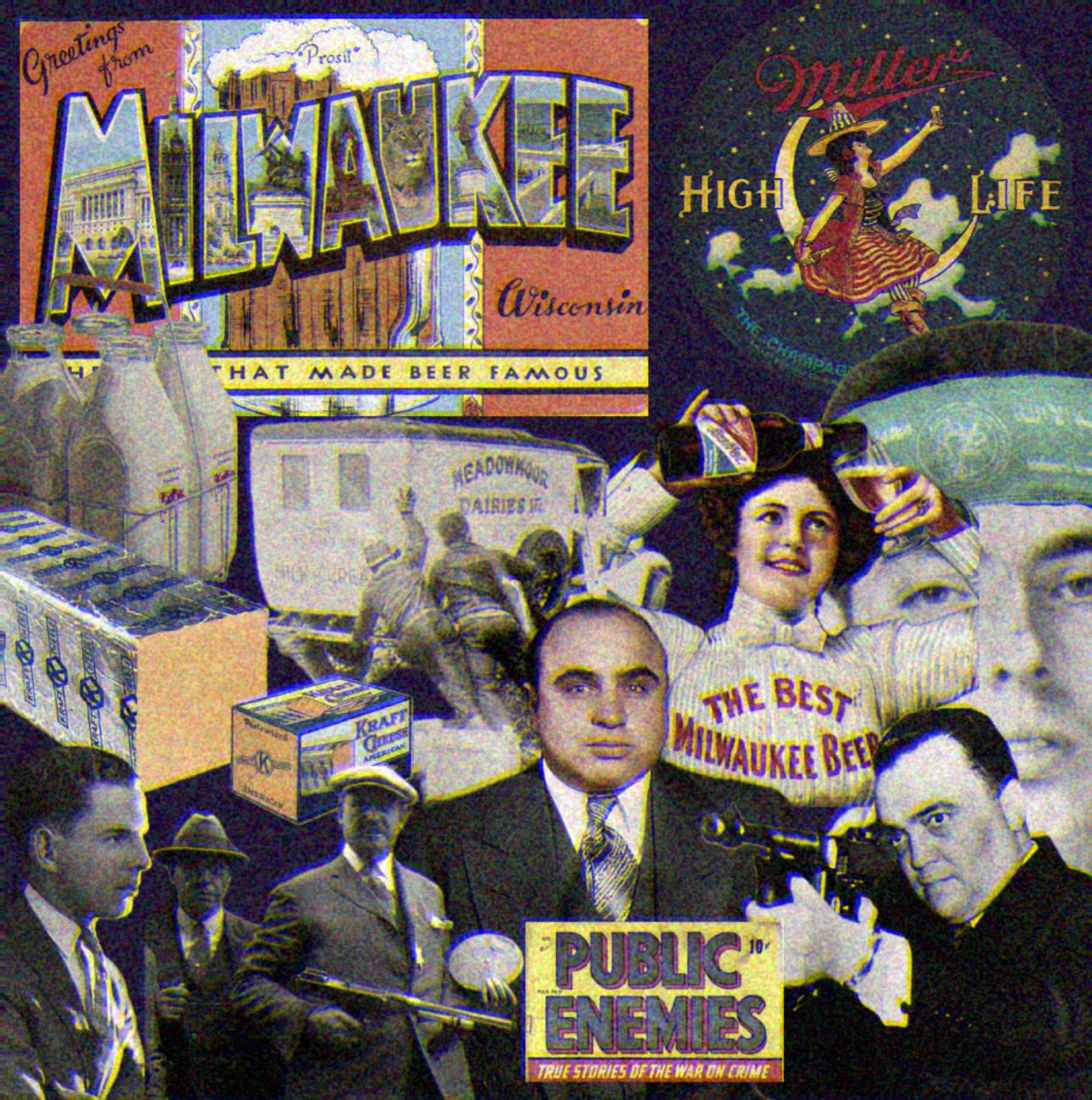
The Klonny has Returned from his podcast-sabbatical as a motorcycle diarist in Latin America to guide you through a decryption of Pynchon’s likely swan song Shadow Ticket, sifting through the subtext to surface the loaded deep political index-names that will help us construct the text-within-the-text (or perhaps ParaPower Map, better yet). In this episode, we synopsize the Milwaukee and Chicago sequences that make up the first half of the novel, zeroing in on the Prohibition era para-parastatal underworld of speakeasies, bootlegger tunnels, and subterranean dynamiter labs and the adjacent rhizome of socialist saloons, Galleanisti anarcho-clubhouses, and union locals in Cream City. We examine how Pynchon’s Reformed Detective Shadowing Cheese Heiress mystery is partly a cipher for the ways in which Capone’s Chicago Outfit and their Milwaukee Mob affiliates sought to complete “transformismo” and earn assimilation into the white color criminal realm of the ruling elite during the Depression’s socioeconomic crisis and contraction, gaining favor through the loyal rendering of anticommunist strikebreaking and labor racketeering services. This tacit deal between the ChiTown upper and underworlds is a minor skeleton key to much of 20th century deep politics by way of the Outfit’s Joe Kennedy ties, the JFK assassination, Sam Giancana’s involvement in the Fidel Assassination Prank Show, GLADIO, and beyond. We start to coalesce theories for why Pynchon is pointing us in this direction including the blatant 1930s - 2020s encroaching fascism parallels; the less-traveled counterinsurgent history of the Pinkertons, J. Edgar Hoover’s early proving of mettle circa Palmer Raids, and the First Red Scare and the way in which there are telling deep event continuities to be traced from the early 1900s to McCarthyism and Cointelpro, early experiments in the strategy of tension playbook; the Bureaus of Investigation and Prohibition and their Wars on Alcohol, Crime, and the Left (including the anti-immigrant and anti-communist targeting of proletarian taverns) and how the Interwar Period gave rise to the modern surveillance and carceral apparatuses; and the secret colonial histories and conflict economies buried inside mundane commodities like cheese and milk.
Shadow Ticket characters index: Hicks McTaggart (rural time / metaphysician JME McTaggart who argued reality is atemporal); Skeet Wheeler (pinmonkey street urchin, Cuno of the story, Zoyd relation?); Boynt Crosstown (man about town pun, U-Ops Private Investigations boss); Free Society of Teutonia (German American Bund predecessor IRL, active in Wisconsin), ‘Ndrangheta mobster Don Peppino (an index-name for Joseph Bonanno); Milwaukee Mobster Lino “the Dumptruck” Trapanese (riffing on the Guardalabene Milwaukee Mob’s actual garbage men racket); proto-MK doctor Swampscott Vobe (evoking Scarsdale Vibe, the Voze dynasty from Amsterdam, and Biz Plotters like Singer Sewing heir Robert Singer Clark); cheese heiress Daphne Airmont (childhood in a sanitarium riffing on colonial crimes like the institutionalization of Anishinaabe Dawn Society visionaries); BOI special agent T.P. O’Grizbee (Touchez pas au grisbi aka Don’t Touch the Loot! Italian-French mob noir reference); Curly Bill Spin gun trick and Curly Capstock (braided references to Murray “the Camel” Humphreys aka Curly Humphreys, the Outfit’s chief union boss kidnapper and labor racket innovator, an Okie); the International Cheese Syndicate (the Pynchon trope of a faceless cabal of transnational capitalists who exploit global Celebrations of Markets and a nifty FinCap pun to boot with Cheese = $); and, of primary focus, Bruno Airmont—the Al Capone of Cheese—and Pynchon’s double feint by way of actual Capone cameos that obscures how Bruno is, in part, a surrogate for Scarfarce Al + Bottles Ralph. A doppelgänger misdirection that leads us back to the Chicago Outfit’s involvement in the Milk Wars and labor and “trade association” rackets.
Themes and motifs filed under: the Business Plot; Wall St. Putsch; American Legion; secret Interior Department treaties; rez blacksites like Cabazon; hypnotherapy; Radium Girls; Prohis, dry agents; curd and whey as a kind of lactic bacteriological capital; curd-lonialism; actual dairy farmer schemes to colonize the vastness of Asia with milk and cheese?; Kraft’s 16 million pounds of pasteurized processed tin cheese sold to the US Army circa WWI; dairies and consumer good megacorps profiting bigtime with powdered milk for the WWII troops and lactic food aid during the occupation of Japan; Kraft; National Dairy Products Co.; Pabst; Brit-Dutch dairy giant Unilever and their vetoing of a Ben & Jerry’s “Free Palestine” watermelon sorbet; U-13 pre-fascist spacetime smuggling sub; Against the Day; Chicago Outfit; Public Enemy #1; Ralph “Bottles” Capone; Frank Nitti; Paul Ricca; Milwaukee’s Vito and Pete Guardalabene and Joseph Vallone; Capones’ lobbying for expiry dates on milk bottles; Volstead Act; 18th Amendment; The War on Alcohol as front in the War on the Left; Milwaukee’s socialist saloons like John Doerfler’s; Sewer Socialism in Cream City; Victor Berger, 1 of 2 socialist congressmen; Socialist Party of Wisconsin (SPWI); Socialist Party USA; CPUSA branch in Wisconsin; communist union victories in Allis-Chalmers; the CPUSA’s People’s Bookshop and Fred and Mary Blair’s Bookshop; commie rags Wisconsin Voice of Labor & Wisconsin People’s Voice; socialist mayors of Milwaukee Emil Seidel, Daniel Hoan, and Frank Zeidler; these pragmatic electoral successes and Milwaukee’s early 20th century hotbed of Communism and anarchism attracting the attention of the feds and psyoperators; collaborationist Social Dem into Republican turncoat DA Winfred Zabel; the Italian Galleanisti Francesco Ferrer social club in the Third Ward (more on this and propaganda of the deed false flags next time); the Free State of Fiume as a parallel to the plan for a tokenized corpo charter city in Gaza with Tony Blair as viceroy; Cream City as microcosm of pre-COINTEL; Chicago Outfit’s labor racket innovations as Trojan Horse for anticommunist infiltration; the Capone Bros’ Milk Moves; Meadowmoor Dairy; mob lawyer William Parrillo; the Milk Wars; National Dairy Products Co. rollup scheme (backed by Goldman Sachs and Lehman Bros) and their Kraft merger; Bruno’s Exile as analogy for the Capone Bros. getting sent to federal pens in Georgia and Alcatraz?; Wisconsin Milk Strikes of 1933; price fixing and the two-tiered milk system (bottled and processed); Outfit getting into dairy to chase white-collar aspirations; Joseph Bonanno’s specialty cheese vicegrip and Fond du Lac, WI presence neighboring Capone; labor racketeer mastermind Curly Humphreys; a momentary theoretical detour exploring Marxist and Neo-Marxist and sociological explanations of the interplay between organized crime and the ruling elite; Gramsci; Adorno; Brecht; Horkheimer; Marx; and a whole lot more.
If you value PPM and my efforts, please subscribe to one of the Patreon’s paid tiers, muchas gracias.
Incomplete List of Sources (may update):
Gus Russo - The Outfit: The Role of Chicago’s Underworld in The Shaping of Modern America
James B. Jacobs - Mobsters, Unions, and Feds: The Mafia and the American Labor Movement
Tim Weiner - Enemies: A History of the FBI
Lisa McGirr - The War on Alcohol: Prohibition and the Rise of the American State
Robert Tanzilo - The Milwaukee Police Station Bomb of 1917
Gavin Schmitt - The Milwaukee Mafia: Mobsters in the Heartland
Nathan Ward - The Lost Detective: Becoming Dashiell Hammett
Bryan Burroughs - Public Enemies: America’s Greatest Crime Wave and the Birth of the FBI, 1933-34
Alfried Schulte-Bockholt - A Neo-Marxist Explanation of Organized Crime
Music (ALL COPYRIGHT FREE BC OF PUBLIC DOMAIN, YOU HEAR ME, SPOTIFY? GODDA*M*T!):
| The Ambassadors, Frank Sylvano - “You’re the Cream in My Coffee” |
| Biltmore Trio - “Love Me or Leave Me” |
| Bessie Smith - “Homeless Blues” |
| Jack Hylton and His Orchestra - “Happy Feet” |
Just catching up on all your Pynchon content... Random Lot 49 question: Why do you pronounce “Pierce” (as in Mr. Inverarity) “Peer-is” rather than “Peerce”? Is there some evidence that Pynchon preferred this very non-standard pronunciation, or is it just a personal verbal tic? I’ve never heard the name pronounced like that, but since you say it that way dozens of times in these episodes, I figure there must be a reason...
this is great